
Teaching AI to talk the way India actually talks
By Sara · · 4 min read
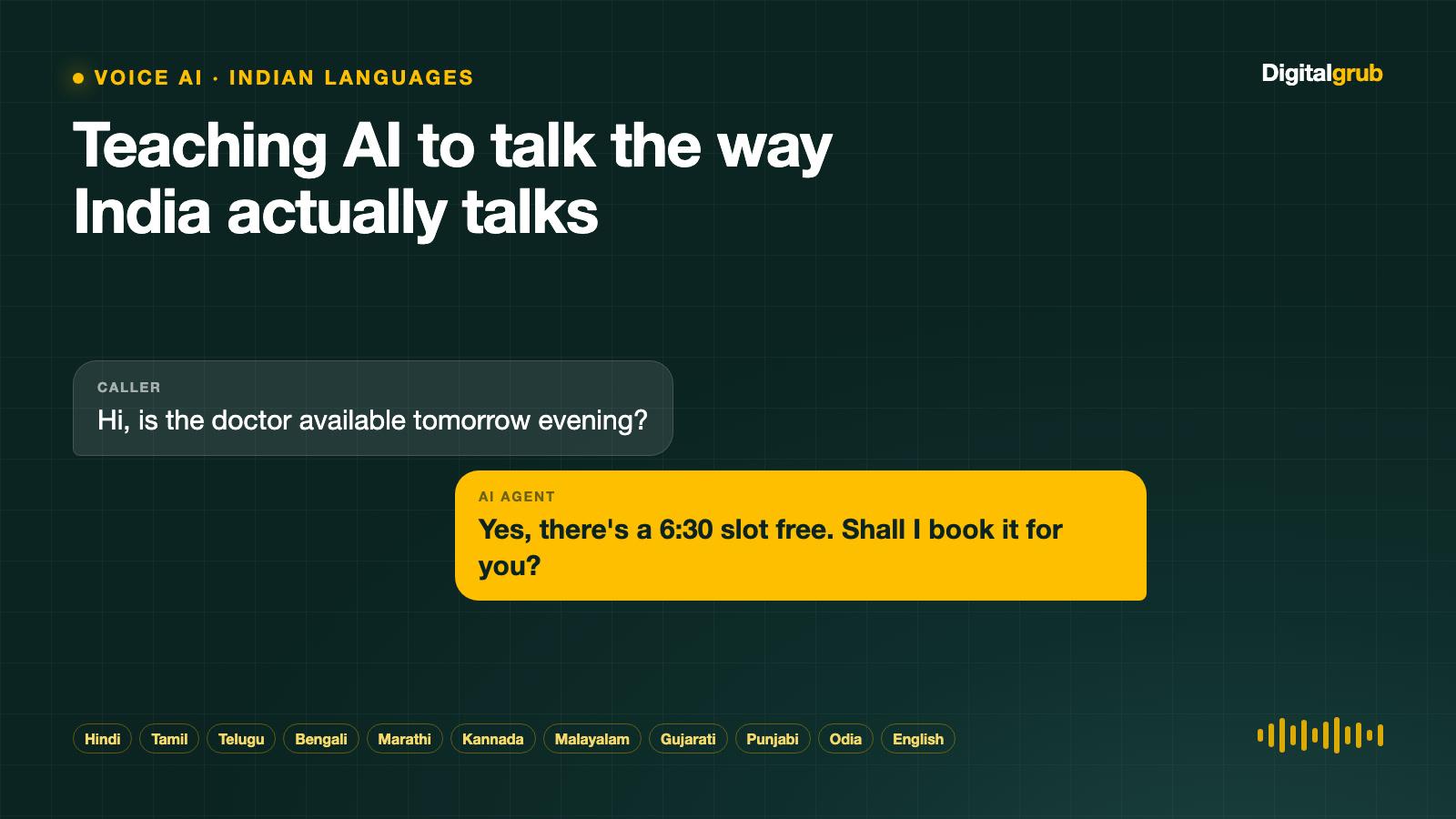
Call a clinic anywhere in India to book an appointment and you will rarely speak just one language. A sentence starts in Hindi, Tamil, Telugu or Bengali and finishes in English, and nobody on either end of the line notices. That is simply how India talks on the phone.
A caller in Tamil Nadu, for example, might ask: “Doctor irukkaangala? Tomorrow evening slot kidaikkuma?” — “Is the doctor in? Can I get a slot tomorrow evening?” Two languages, one breath, and a perfectly ordinary question.
For years, that made automated phone systems close to useless here. They were built for English, and a caller who switched languages halfway through a sentence broke them. That has changed quickly, and it is worth understanding what changed — whether you run a clinic, a shop, a college office or a sales team.
What a voice agent actually does
A voice agent is software that picks up a phone call and holds a real conversation. It does four things, over and over, quickly enough that it feels like talking to a person:
- It listens — and knows when you have started and finished speaking, so it never talks over you.
- It understands what you are asking, even when the sentence moves between an Indian language and English.
- It answers out loud, in a voice that sounds like it belongs in the language you are speaking.
- It acts — books the slot, checks the order, notes the enquiry, or hands the call to a person.
Why Indian languages were the hard part
Getting a machine to hold a phone conversation in English was solved years ago. Indian languages brought three problems English never had.
- People mix languages. Callers move between their own language and English inside a single sentence. Older phone systems handled one language per call and stumbled the moment someone dropped an English word like “appointment” into the middle of a sentence.
- Things have to be said the way people say them. A booking written as “Dr. Sharma, 18 Jan, 7:30 AM” has to be read out the way a person would say it in the caller’s language — the title in full, the date and the time spoken naturally. For a Tamil caller, “18 Jan, 7:30 AM” should come out as “January padhinettaam thedhi, kaalai ezharai mani” — not read out character by character like a machine reading a form.
- The rhythm is different. Indian languages do not rise and fall the way English does. A voice trained on English sounds foreign here even when every word is correct.
What changed is that India started building its own voices.
Research groups like AI4Bharat at IIT Madras, and Indian companies like Sarvam, have trained speech models on Indian voices instead of adapting English ones. The newest of them handle a sentence that mixes an Indian language with English in one go, without the awkward pause where the accent switches. That one change is what turns an Indian-language phone agent from a demo into something a business can actually put on its number.
What it could do for a business here
- A clinic that answers every appointment call in the patient’s own language — including the ones at 10pm — and calls the day before as a reminder.
- A college admissions office that answers the same fifty questions a thousand times every June, in the caller’s own language.
- A sales or real estate team whose new enquiries are called back within a minute, with a note on who is serious.
- A shop or distributor that tells a caller where their order is, without anyone having to look it up.
Where Digitalgrub is in this
None of this is new ground for us. The Indian-language part is where our research is right now, and it builds on work we have already done.
- We have built AI phone agents. Our candidate screening system calls applicants, holds a screening conversation, and passes only the qualified ones forward.
- We have turned speech into records. In a proof of concept for healthcare, spoken clinical notes became structured data — the listening half of the same problem.
- We publish in an Indian language every day. tnjobs.site writes and publishes a regional-language news article daily, unattended.
What we are researching now is bringing those together: an agent that answers a call in the caller’s own language, sounds like it belongs here, and does something genuinely useful before it hangs up. We have not shipped one yet, and we will not pretend otherwise — when we do, it will be written up here with a number you can ring and test yourself.
Working with us
If your business spends its day answering the same calls — appointments, admissions, orders, enquiries — and your callers would rather speak their own language, that is exactly the problem we want to work on with you.